
Premises for a minimally healthy society
This article is only a preface to a larger book that may (or may not) come out, depending on the path we take as a society. Given the polarisation and the binary left/right thinking that dominates the collective unconscious, reading this text will be an exercise in ideological neutrality, quite a challenge these days. For some it may make sense a few years from now, and for others perhaps never. And that is fine. The aim is to encourage reflection on the need to remodel our political system, starting from the premise that decades pass and Brazil keeps dragging its feet. In this book I will propose a design for a new electoral model, based on the concept of Futarchy.
As long as politics is treated as a circus, society will play the clown.
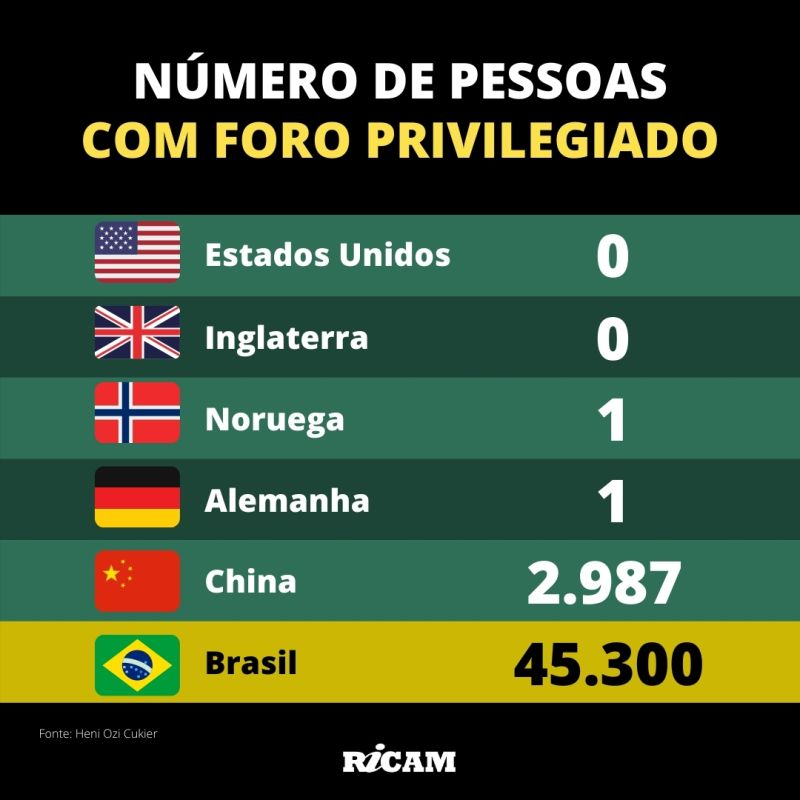
Here in Brazil we have a peculiar habit of worshipping authority. We are very quick to absolve politicians of blame for wrong decisions and actions. The media even puts on a little mise-en-scène now and then, but that depends on the editor and the agenda. Very serious mistakes by politicians are easily forgotten, and those in office carry on in the profession most coveted by anyone seeking the greatest power: being elected. The moment they win an election, they become a mixture of authority and celebrity, with a great deal of power and special treatment, practically above the law. And the interesting thing is that we love this as a nation. We cheer for them, fight for them, protect them (from whom?)… We unconsciously enjoy this business of special jurisdiction for officeholders, the Foro Privilegiado. Brazil holds the record for protecting “authorities”, with more than 45,000 special people above the law. Someone has very probably already drawn a connection between this worship of authority and the Discovery of Brazil. We are still the same naive people, natives worshipping “supermen”. Which would explain another culture that remains very strong today and is also linked to politics: Coronelismo.
Figure 01 · Reading the original
Special jurisdiction for officeholders
No date on the figure
Numbers attributed to six countries in the essay’s image.
| Country in the figure | People |
|---|---|
| United States | 0 |
| England | 0 |
| Norway | 1 |
| Germany | 1 |
| China | 2,987 |
| Brazil | 45,300 |
Editorial note
The image gives no date or methodology. The numbers and the equivalence of the countries’ legal arrangements have not been confirmed in a primary source.
The label “England” has been kept as it appears in the image, which uses the United Kingdom’s flag.
Printed credit: Heni Ozi Cukier; RICAM brand.
View original figure: Special jurisdiction for officeholders
Images have been preserved as they appear in the original Portuguese document. Accessible data, labels and descriptions follow the language of this edition.
Figure text in Portuguese
Number of people with special jurisdiction
 Open full-size image (PNG) (opens in a new tab)
The figure of the Colonel-Politician may have made sense to some in times when information was scarce. Those who understood nothing ended up obeying the most powerful.
The greatest Stockholm Syndrome on the planet is probably the relationship between Brazilians and politicians. The Politician is a necessary evil who must be treated with great caution and rigour. They have access to the people's capital and tend to spend irresponsibly, when they are not spending it on themselves. Understanding this is the central premise for any minimally healthy society. A politician is not an “authority”. A politician is a servant of the people. A coherent image of a politician would be someone very tense, distressed by the complexity of the mission ahead. Exactly like a CEO taking over a completely bankrupt company with virtually every indicator looking terrible. I admit I have never understood that celebration they put on when they win an election, as though they had won the World Cup.
“When bankers dine together, they talk about art. When artists dine together, they talk about money.” - Oscar Wilde
This political model of ours has been proving flawed because it ultimately cannot reconcile electoral rhetoric with political coordination and implementation, which is essential if society is actually to progress. Politicians are human beings who are extremely skilled at capturing the anxieties of society at a given moment. They then present themselves as legitimate representatives of the crusade against social ills when they are finally elected. From that point, the political-theatrical triad begins: the actors (politicians), the script (rhetoric) and the audience (the citizen). And the end result is the shit we have had for decades. (“Merda”, Portuguese for “shit”, is a cry of good luck used whenever an actor goes on stage. One actor may wish “merda” to another who is stepping onto the stage. The story behind the term goes back to the smell of horse manure around the theatre. When a play drew a large audience, many horses were “parked” outside. So, leaving a well-attended performance came with an iconic smell.)
“Do you know the difference between a statesman and a demagogue when making decisions? One decides with the next elections in mind, while the other thinks of the next generations.” - Winston Churchill
Another point: all the population's energy goes into the electoral process. Once politicians are elected, only the media actually “follows” what those in office are doing, intervening or not according to its interests. There is no culture of demanding results from public authorities. “How much does each of these trips the Ministers are taking cost??” “How can a judge travel on a Brazilian Air Force (FAB) jet to watch a Champions League match?!” “Why are they resurfacing the road again?” “How much did this event cost the public purse?” Of course, the media stages its demands when it suits. But there is no culture of monitoring government spending. The lack of transparency in the management of public money has historically provided a windfall for the King's friends. Imagine if the government publicly presented a quarterly income statement (DRE), as companies do?
“When Law and Morality are in contradiction, the citizen faces the cruel choice of losing a sense of Morality or losing respect for the Law, both great misfortunes between which it is difficult to choose.” - Fréderic Bastiat (1801 - 1850)
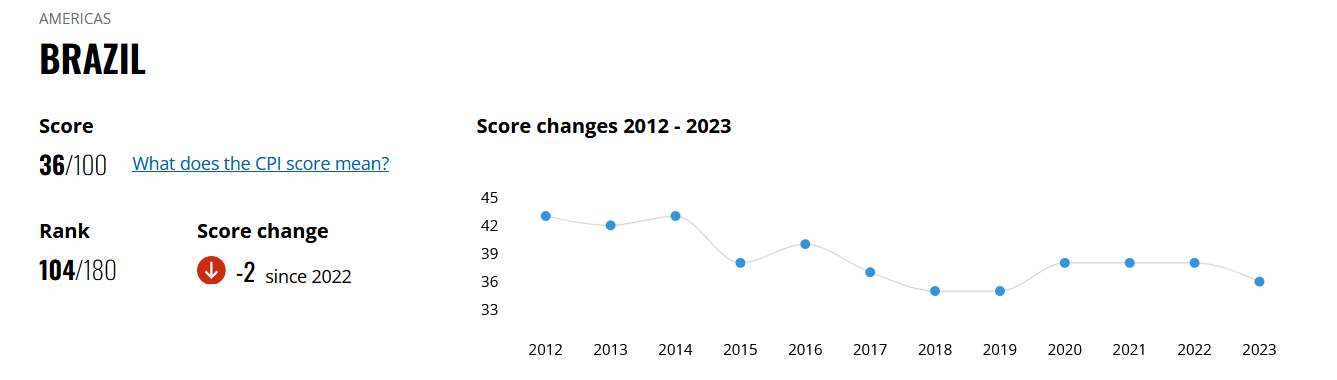
Our political system is one of the most corrupt on the planet. In the Corruption Perceptions Index (https://www.transparency.org/en/cpi/2023/index/bra), Brazil scored 36/100 in 2023, ranking 104th out of 180 countries monitored. In 2024 this is likely to get worse with this chaos in the Judiciary. Absolute transparency and freedom of information are the citizen's only defences and must be defended above any ideological difference.
Figure 02 · Reading the original
Perception of corruption
Brazil · 2023 edition
Corruption Perceptions Index results included in the document.
- Score
- 36/100
- Rank
- 104thamong 180 countries and territories
- Change
- −2points compared with 2022
Editorial note
The index measures perceived corruption in the public sector, according to experts and businesspeople. On its 0–100 scale, a higher score indicates lower perceived corruption.
The screenshot also shows the trajectory from 2012 to 2023, without numerical values at each point. These are historical results, not updated data.
Source: Transparency International, CPI 2023.
View original figure: Perception of corruption
Images have been preserved as they appear in the original Portuguese document. Accessible data, labels and descriptions follow the language of this edition.
Figure text in English
Brazil
Americas
What does the CPI score mean?
Score changes from 2012 to 2023
The chart shows one point for each year from 2012 to 2023 and vertical-axis marks at 33, 36, 39, 42 and 45. It shows fluctuations and an overall decline during the period. No values are printed at the points; no intermediate values have been estimated.
 Open full-size image (PNG) (opens in a new tab)
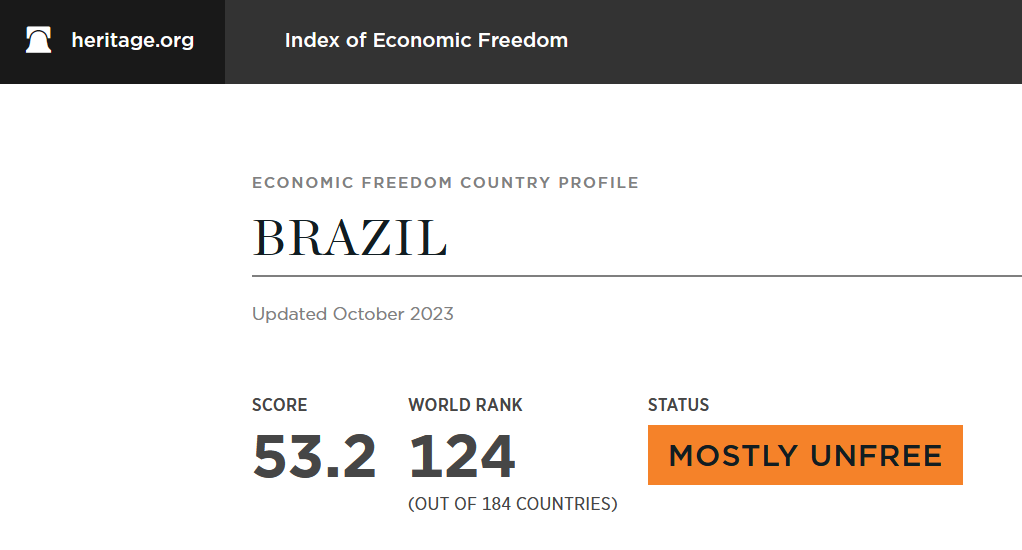
In the economic freedom ranking (Index of Economic Freedom 30th Edition https://www.heritage.org/index/), updated in October 2023, we rank 124th (North Korea is 176th). The government should make things as easy as possible for every business that creates jobs. Employment is the best social programme of all. Employment frees people and gives them dignity. And the government should work towards this individual financial freedom. But if we take a careful look, we see that the government works towards citizens' absolute financial dependence. Keeping people dependent on the State is valuable to politicians: it means keeping power. That old maxim: “if the State controls your employability, it controls you completely.”
Figure 03 · Reading the original
Economic freedom
Brazil · 2024 edition
Numbers from the original screenshot, confirmed in Heritage’s 2024 country profile.
- Score
- 53.2
- World rank
- 124th
- Classification in the figure
- Mostly unfree“Mostly unfree”, in the index’s terminology.
Editorial note
The score and rank correspond to the 2024 edition. The official profile states that the data were compiled up to October 2023, the date also shown in the screenshot.
The image mentions 184 countries. The report covers 184, of which 176 received a score. The classification follows Heritage’s criteria.
Source: The Heritage Foundation, Index of Economic Freedom.
View original figure: Economic freedom
Images have been preserved as they appear in the original Portuguese document. Accessible data, labels and descriptions follow the language of this edition.
Figure text in English
Brazil
Index of Economic Freedom
Economic freedom country profile
Updated October 2023
Out of 184 countries
 Open full-size image (PNG) (opens in a new tab)
“When people want the impossible, only liars can satisfy them.” - Thomas Sowell
Ideology is an excellent tool for manipulating the political game because it reinforces society's differences. The result, of course, is a chaotic social split like the one we see here in Brazil, and one that is increasingly visible around the world in general. Nothing could be “wiser” than setting people against each other, promoting the idea that one person's ideology is responsible for another's distress. Let us return to the theatre: we human beings love a duel and a soap opera. Sport and theatre have always been part of our daily lives, and Manichaeism has always been present in our imagination. If social chaos appears, then we need a saviour capable of “reading our anxiety”. And a timeless script that has historically worked is the great warrior who saves the most vulnerable. And as a reward for bravery, “take more power and spend whatever is needed to strengthen the State and ward off future enemies…” This is a winning script. But… In the end it changes nothing except keeping the politician exactly where they want to be: in power. And it all starts again, elections, anxieties, promises, power. On a loop.
“Who controls the past controls the future. Who controls the present controls the past.”
- George Orwell, 1984
The media still plays a decisive role in shaping opinion, capable of moulding exactly how society thinks. Not everyone has yet understood how liberating the active search for information is, now possible thanks to platforms such as X. And orchestrating a society's evolution requires common sense and collective responsibility. The evolution of any organism on this planet follows an arduous and challenging path. A well-raised child certainly did not do whatever they wanted all the time. A company that grows and prospers certainly goes through many moments of decidedly unpopular decisions, because these “difficult and unpopular decisions” are part of any development. The media cannot use ideology to challenge unpopular decisions that are necessary for society's long-term development. It ought to be the duty of a mature, responsible media to help explain cause and consequence for every unpopular decision. Manipulation of facts and even of the past, as frequently happens here in Brazil, are the mainstream media's greatest acts of irresponsibility towards society.
Look at the culture of censoring “Fake News”, in which the State controls the “truth”. Look at the newspapers' main daily topics: the power game, violence and saviour populism. The more insecure and dependent on the State you feel, the more power politicians will have.
“Divide and conquer” ― Julius Caesar
Ideological thinking divides society and allows politicians to control it more easily. There should be just one “ideology”: keeping politicians in check so that they actually do what needs to be done for society as a whole to progress. There is no magic: a healthy society develops over the long term, with work carried out responsibly by politicians. The political-theatrical circus that the media helps maintain is the worst enemy of the development of a healthy society.
“We cannot solve a problem using the same reasoning that was used to create it.” Einstein
Our political model needs to be rethought. As things stand, the years will keep passing and progress will remain distant. Have you heard of Robin Hanson's “Futarchy”? It would be wonderful if we had media providing this kind of discussion… Futarchy is a model that uses Game Theory to derive a political and economic system in which the market becomes “hostage” to the population's interests. It is a blend of Capitalism and Socialism. Futarchy starts from the principle that the human being (the politician) is selfish and individualistic and, with power, tends to arrange benefits for themselves. Based on this premise, the model works with depersonalised Values and Measures. It is no longer a politician wanting to do something... It is “what” and “how” we need to do it. To sum up: the population votes on Values, the market votes on Measures. Forget the theatre. Forget the electoral lies. It is a creative and disruptive exercise. And the question that remains is: how much would social efficiency increase if the discussion were NO longer about people (politicians), but about Socioeconomic GOALS and how to achieve them?